loader
We're Here to Help Sales & Support: (866) 620-2831

Shopping Cart ( 0 )

Your Have 0 Item In Your Cart

close

No products in the cart.

Blog

GE vs Mindray Ultrasound Machines Compared
Summary

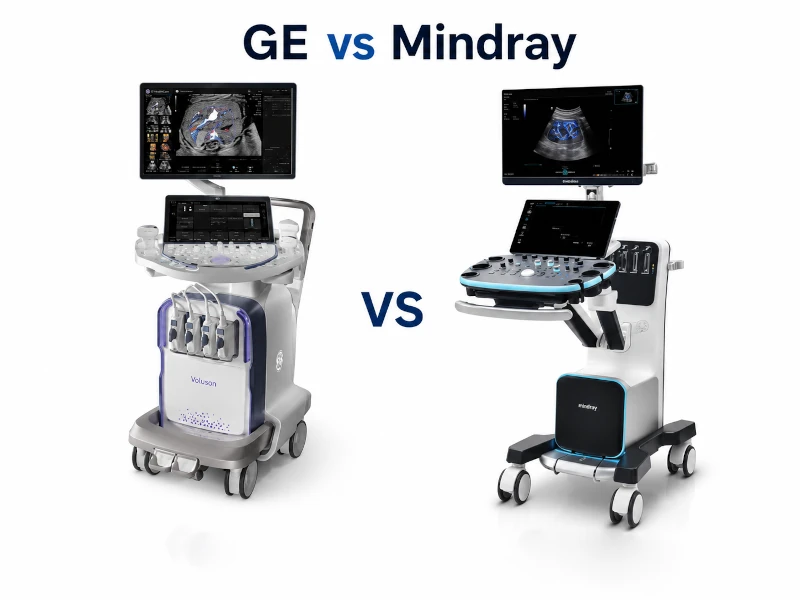
GE and Mindray can both be strong ultrasound options, but they often appeal to different veterinary buyers. GE may suit clinics looking for established medical imaging technology, premium refurbished systems, advanced imaging, cardiology, or broad diagnostic capability, while Mindray may suit practices wanting veterinary-focused systems with dedicated animal workflow, portable and cart-based options, and strong value.

Introduction

GE vs Mindray is not just a “which brand is better?” comparison. GE HealthCare is a long-established medical imaging company with ultrasound families such as LOGIQ, Versana, and VIVID, while Mindray Animal Medical offers dedicated veterinary ultrasound systems designed for animal care workflows.

GE’s veterinary ultrasound portfolio includes portable systems, Versana, LOGIQ general imaging, and VIVID cardiovascular ultrasound. Mindray veterinary ultrasound systems include both cart-based and portable options designed for image quality, dedicated veterinary parameters, and user-friendly workflow. 

This comparison looks at where GE and Mindray differ in real veterinary use, what each brand may do well, and what buyers should check before choosing a system.

Quick Verdict: GE or Mindray?

GE may be the better fit for clinics that want advanced imaging capability, premium used or refurbished equipment, cardiovascular ultrasound options, LOGIQ general imaging systems, or a broader medical imaging platform adapted for veterinary use.

Mindray may be the better fit for veterinary clinics that want systems designed directly for animal imaging, including portable and cart-based Vetus options for small animal, mixed-practice, and some large animal workflows.

The better choice depends on the same factors involved in choosing the right veterinary ultrasound system: the exact model, probe package, software options, condition, support, and the exams performed most often. 

The Main Difference: Established Imaging Platform vs Veterinary-Focused Workflow

GE often appeals to buyers because of its long medical imaging background and broad ultrasound portfolio. Its veterinary ultrasound page positions LOGIQ systems for abdominal imaging, oncology assessment, biopsy guidance, pregnancy monitoring, reproductive evaluation, and exotic species diagnostics. GE also positions VIVID systems for veterinary cardiac assessment, from routine screening to complex care.

Mindray is easier to position directly inside veterinary care because its Animal Medical ultrasound range is built around veterinary applications. Its product category includes cart-based systems such as Vetus 9, Vetus 8, Vetus 7, Vetus 50, Vetus 5Exp, and Vetus 5, along with portable systems such as Vetus E7, Vetus EQ, TE5 Vet, Z60 Vet, DP-50 Vet, DP-30 Vet, and DP-10 Vet.

GE may feel stronger for buyers who want an advanced or premium medical imaging platform. Mindray may feel more straightforward for practices that want a veterinary-ready system with animal-focused workflow from the start.

Where GE Has the Advantage

GE may stand out when buyers need advanced abdominal imaging, cardiac or cardiovascular ultrasound, referral-level diagnostics, biopsy or guided-procedure support, premium used or refurbished systems, broad probe and software options, or a system family that can cover both routine and advanced exams.

GE’s LOGIQ family covers a broad range of clinical applications, from routine diagnostics to contrast, elastography, invasive ultrasound, biopsies, and volume navigation. For veterinary buyers, that can make GE especially interesting when the clinic needs more than basic abdominal scanning.

Best GE Fit

GE may be a stronger choice for referral hospitals, specialty veterinary clinics, advanced small animal practices, veterinary cardiology users, clinics considering refurbished premium systems, and practices that need broad diagnostic capability.

A small animal referral hospital, for example, may value a GE system for abdominal imaging, cardiac work, guided procedures, and specialist diagnostics. A general practice may also consider GE, especially if it finds a well-tested refurbished system with suitable probes and support.

Where Mindray Has the Advantage

Mindray may stand out when buyers want dedicated veterinary ultrasound systems, portable and cart-based options, veterinary presets, animal-focused parameters, practical clinic workflow, and a balance of features, usability, and budget.

Mindray’s veterinary imaging page describes its ultrasound solutions as including both cart-based and portable systems, designed to support diagnostic confidence with image quality, dedicated veterinary parameters, and user-friendly workflow. This gives buyers a more direct veterinary product line to compare, rather than adapting a broader human medical imaging platform to animal care.

Best Mindray Fit

Mindray may be a stronger choice for general veterinary clinics, small animal practices, mixed practices, clinics buying their first serious ultrasound system, practices wanting veterinary-specific presets, and buyers comparing new, used, or refurbished veterinary systems.

For many clinics, the appeal is practical. Mindray gives buyers a clear veterinary range, with systems that can be compared by budget, portability, workflow, and probe needs.

Clinic Workflow: Which Brand Feels Easier Day to Day?

Workflow can matter as much as image quality. A clinic with multiple users may need intuitive controls, repeatable presets, simple reporting, fast exam setup, and easy probe switching.

GE can be strong when a clinic wants advanced tools and a system family with broad clinical capability. GE’s Versana systems are positioned around intuitive design, automated tools, broad applicability, and use in private clinics, GP offices, and specialist settings.

Mindray may feel easier for veterinary teams that want a system already designed around animal imaging rather than adapting a human clinical system to veterinary work. This can be useful for clinics that want species-focused workflow and a smoother learning curve for everyday scanning.

Image Quality and Advanced Features

GE should not be considered automatically better just because it is a major imaging brand, and Mindray should not be considered automatically better just because it is veterinary-focused.

A high-end GE system may offer stronger advanced imaging tools than an entry-level Mindray system. But a newer Mindray veterinary system with the right probes and presets may be much more practical than an older GE unit without suitable probes, software, or service support.

Buyers should compare sample images from the exact machine, probe condition, Doppler performance, imaging depth, software options, monitor quality, presets, workflow speed, and service history.

The better image usually comes from the right system, the right probe, the right settings, and an experienced user, not the brand name alone.

Portability: GE and Mindray Take Different Paths

Both brands can be considered for portable use, but the buying logic is different.

GE’s veterinary portfolio includes portable solutions built on VIVID, LOGIQ, or Versana technology. GE lists portable veterinary applications such as equine field diagnostics, large-animal emergency assessment, stable-side reproductive checks, farm calls, and mobile practice services.

Mindray also offers portable veterinary systems, which may be attractive for clinics that want animal-focused portability and veterinary workflow in one package. Its veterinary category includes portable systems such as Vetus E7, Vetus EQ, TE5 Vet, Z60 Vet, DP-50 Vet, DP-30 Vet, and DP-10 Vet.

GE may be more appealing when portability needs to come with advanced imaging families. Mindray may be more direct when the buyer wants portable veterinary ultrasound for everyday animal care.

Probes May Decide the Better Purchase

GE vs Mindray often comes down to the probe package. A premium GE system without the right veterinary probes may be less useful than a Mindray system already configured for the clinic’s daily exams. A Mindray system with limited or damaged probes may also be a poor buy compared with a well-tested GE system.

Veterinary buyers may need convex probes, linear probes, and micro-convex probes, along with phased-array probes for cardiac exams, high-frequency probes for exotic animals and small patients, and rectal or specialty probes for large animal or reproductive work. 

Before deciding, buyers should ask for probe test images, cable condition, lens condition, connector checks, and replacement costs. Probe condition can change the real value of the purchase more than the brand name.

Used or Refurbished: Which Brand Makes More Sense?

GE may be attractive on the used or refurbished market because buyers can sometimes access advanced LOGIQ, Versana, or VIVID systems at a lower upfront cost. The risk is that older systems need careful review for service history, probe condition, software options, and probes and parts availability. 

Mindray may be attractive used or refurbished because its veterinary-specific Vetus systems can fit small animal and mixed-practice workflows directly. Buyers should check the exact model, included probes, Doppler features, veterinary presets, battery condition for portable units, warranty, and seller support.

For both brands, the safest used or refurbished ultrasound systems are tested units with clear probe details, sample images, warranty or return terms, and available service support. 

Common Mistakes When Comparing GE and Mindray

Avoid choosing GE only because it is a premium imaging brand. Also avoid choosing Mindray only because it is veterinary-specific. Neither shortcut is enough.

Common mistakes include comparing brand names instead of exact models, ignoring probe compatibility, assuming every system includes Doppler, buying a used system without test images, forgetting software options and service history, choosing an advanced system when the clinic needs simple workflow, or choosing a cheaper system that cannot support daily imaging needs.

The right ultrasound system should match the practice’s real case load, not just the reputation of the brand.

Final Recommendation

Choose GE if the practice needs advanced imaging, cardiology, referral-level diagnostics, broad clinical capability, or a premium refurbished system with the right probes and support.

Choose Mindray if the practice wants a veterinary-focused ultrasound system, dedicated animal workflow, portable and cart-based options, and a practical fit for small animal or mixed-practice use.

GE may be the stronger choice for advanced imaging and premium clinical capability, while Mindray may be the more practical choice for many veterinary clinics that want a dedicated animal-focused ultrasound system.

FAQ

Is GE better than Mindray for veterinary ultrasound?

GE is not automatically better than Mindray. GE may be stronger for advanced imaging, cardiology, and premium refurbished systems, while Mindray may be better for veterinary-specific workflow, small animal clinics, and mixed-practice use.

Is Mindray good for veterinary clinics?

Yes. Mindray offers veterinary ultrasound systems, including cart-based and portable options with dedicated veterinary parameters and user-friendly workflow.

Is GE ultrasound suitable for veterinary use?

Yes. GE HealthCare has a veterinary ultrasound portfolio that includes portable systems, Versana, LOGIQ general imaging, and VIVID cardiovascular ultrasound options for veterinary applications.

Which brand is better for veterinary cardiology?

GE may be especially relevant for veterinary cardiology because its VIVID family is positioned for cardiovascular ultrasound and veterinary cardiac assessment. Mindray may also be suitable depending on the model, probes, and cardiac software options.

Which brand is better for regular small animal clinics?

Mindray may be more direct for regular small animal clinics because it offers dedicated veterinary systems. GE may also be a strong option if the clinic wants advanced imaging or is considering a tested refurbished system.

Should I buy a used GE or Mindray ultrasound machine?

Either can be worth buying if the system is tested, includes suitable probes, has the needed software, and comes with reliable support. For GE, check age, software, and service history carefully. For Mindray, check the exact Vetus model, veterinary presets, probes, and battery condition if portable.

What should I compare before choosing GE or Mindray?

Compare the exact model, probe package, image quality, Doppler features, veterinary workflow, portability, software options, service history, warranty, and whether the system fits your most common veterinary exams.
Canon vs Mindray Ultrasound Machines Compared

Summary

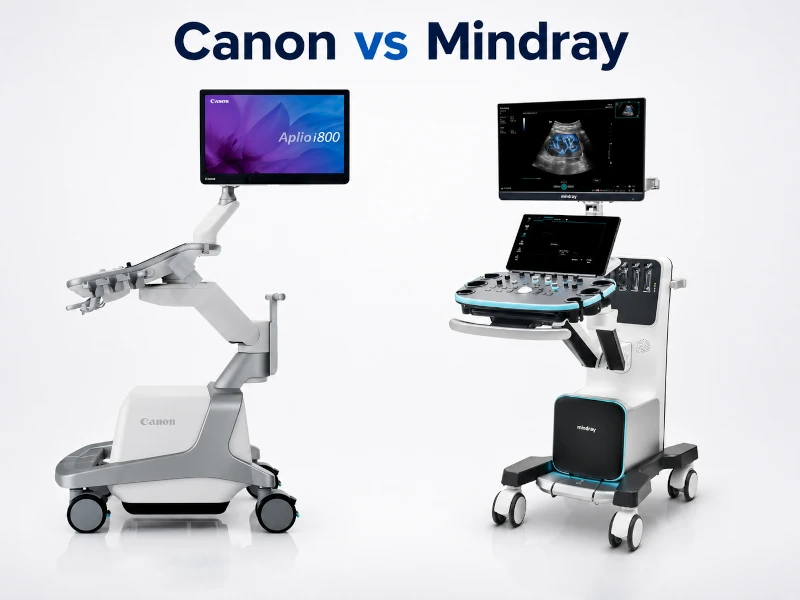
Canon and Mindray can both be considered for veterinary ultrasound, but they usually appeal to different buyers. Canon may suit clinics looking for advanced imaging performance and specialty capabilities, while Mindray may suit veterinary practices wanting a broader veterinary-focused range, including portable and cart-based systems.

Introduction

Canon vs Mindray is not a simple “better brand” comparison. Canon Medical is widely known for advanced clinical ultrasound platforms such as the Aplio i-series, Aplio a-series, and Aplio flex. Mindray Animal Medical, on the other hand, offers Mindray veterinary ultrasound systems designed specifically for animal care workflows. 

Canon describes the Aplio i-series / Prism Edition as offering AI-assisted productivity and imaging functions, while Aplio flex is positioned as a mobile system with smart imaging and workflow functions for busy clinics. Mindray lists veterinary ultrasound systems such as Vetus E7 and Z60 Vet, with systems designed for mobility, veterinary workflow, and animal care environments.

This guide compares Canon and Mindray by clinical fit, image quality, veterinary workflow, portability, probe needs, used/refurbished value, and long-term support.

Quick Verdict: Canon or Mindray?

Canon may be the better fit for specialty clinics, referral hospitals, advanced small animal imaging, cardiology, exotic animal imaging, and practices that want premium imaging tools from a major medical imaging brand.

Mindray may be the better fit for general veterinary clinics, mixed practices, buyers who want veterinary-specific systems, and practices comparing portable and cart-based ultrasound options at different price levels.

The right choice depends on the same factors involved in choosing the right veterinary ultrasound system: the exact model, probes, software options, condition, support, and the exams your practice performs most often. A high-end Canon system may be excellent for referral imaging, but a Mindray veterinary system may be more practical for a general clinic that needs species presets, daily usability, and a simpler veterinary workflow.

The Main Difference: Advanced Medical Platform vs Veterinary-Focused Range

Canon is often considered when a veterinary clinic wants advanced imaging capability, especially if the buyer is looking at premium clinical ultrasound systems that can also fit veterinary applications. The Aplio i-series / Prism Edition includes flexible AI-assisted productivity functions, imaging tools, and workflow customisation. Aplio flex is described as a mobile system with smart imaging and workflow functions for a wide variety of imaging needs in busy clinics.

Mindray is easier to position directly inside veterinary care because Mindray Animal Medical offers a dedicated veterinary ultrasound lineup. Its veterinary systems include portable and hand-carried options such as Vetus E7 and Z60 Vet, and Mindray describes the Vetus E7 as a laptop-based system designed for mobility and reliability in a compact format.

Canon feels more like a premium clinical imaging option that may suit advanced veterinary environments. Mindray feels more like a veterinary-focused option that may suit a wider range of everyday clinic and mixed-practice workflows.

Where Canon Has the Advantage

Canon may stand out when the buyer needs high-end image quality, advanced Doppler or vascular imaging tools, specialty small animal imaging, cardiac or referral-level workflows, exotic animal imaging, premium software tools, or a used/refurbished system with strong imaging potential.

Canon has also published veterinary imaging examples involving Aplio systems. One Canon article describes the Aplio i800 being used in exotic animal care for abdominal and thoracic exams, ultrasound-guided biopsies, nerve blocks, and echocardiography. The same example highlights high-resolution imaging, high-frequency transducers, and a wide transducer range as important factors in that setting.

Best Canon Fit

Canon may be a stronger choice for referral hospitals, specialty veterinary clinics, advanced small animal practices, exotic animal clinics, veterinary cardiology users, and buyers considering premium refurbished ultrasound systems.

Canon makes the most sense when a practice can actually use the advanced capability. A general clinic doing only basic screening may not need the same system as a referral hospital performing complex abdominal, cardiac, or guided-procedure work.

Where Mindray Has the Advantage

Mindray may stand out when the buyer wants veterinary-specific ultrasound systems, portable and cart-based choices, dedicated veterinary parameters, a broader range of models at different price levels, and systems designed directly for animal care environments.

Mindray’s veterinary lineup includes hand-carried and portable systems such as Vetus E7 and Z60 Vet, along with wider Vetus-series options. The Z60 Vet is described as a portable Color Doppler veterinary ultrasound system with image quality and advanced features, while the Vetus E7 is described as a compact laptop-based veterinary ultrasound system. Mindray’s Vetus 8 is also presented as a professional veterinary solution for a wide range of species, from small pets to large farm animals.

Best Mindray Fit

Mindray may be a stronger choice for small animal clinics, general veterinary practices, mixed practices, clinics wanting a balance of value and features, buyers needing portable or cart-based choices, and practices looking for veterinary presets and workflow support.

Mindray is often easier to evaluate as a veterinary purchase because the product range is already positioned around animal care rather than adapted from a general medical imaging platform.

Image Quality: Do Not Compare by Brand Name Alone

Canon may have the stronger premium-imaging reputation, especially in advanced clinical systems, but that does not automatically make every Canon system the better veterinary purchase. A newer, properly configured Mindray veterinary system may be more useful for a clinic than an older Canon system without the right probes or software.

At the same time, a well-maintained refurbished Canon system may offer excellent value for a specialty clinic that needs higher-end imaging. Canon’s Aplio i-series materials describe enhanced resolution, penetration, expert tools, and microvascular imaging technology for low-flow visualisation. These features may matter for specialist cases, but only if the veterinary team has the probes, training, and workflow to use them.

Buyers should compare sample images from the exact machine, probe quality, imaging depth, Doppler performance, software packages, display quality, workflow speed, and service history. The better image is not always from the more famous brand; it usually comes from the right system, right probe, correct settings, and experienced user.

Veterinary Workflow: Where Mindray May Feel Easier

Workflow matters, especially in a clinic where multiple staff members may use the machine. Mindray has an advantage when the buyer wants a system designed directly around veterinary use, species-oriented workflow, and animal care needs.

Mindray’s Vetus 8 materials describe the Vetus series as professional veterinary solutions for a wide variety of species, from small pets to large farm animals. For many general clinics, that direct veterinary positioning may make the buying process simpler. Buyers can look at species needs, probe options, presets, and workflow features without needing to adapt a human-focused system.

Canon may still work very well in veterinary settings, but buyers should confirm that presets, measurements, reporting, image export, and probe options fit the way the clinic scans animals.

Specialty Imaging: Where Canon May Pull Ahead

Canon becomes more interesting when the clinic is not only doing basic abdominal scans. Canon may be more attractive for advanced abdominal imaging, cardiac imaging, exotic animal imaging, microvascular imaging, guided procedures, referral-level diagnostics, and specialist soft tissue exams.

Canon’s Aplio i800 example in exotic animal care is especially relevant because it includes abdominal and thoracic exams, biopsies, nerve blocks, and echocardiography. It also notes the use of high-frequency probes, including a 22 MHz hockey-stick transducer for very small patients. Canon’s advanced application materials also describe tools for interventional procedures, including Smart Fusion, Smart Navigation, and virtual biopsy-line guidance.

Canon is not automatically better for every specialty practice, but it may be better suited when the exact model, probes, and software match the clinic’s advanced imaging needs.

Portability and Daily Use

Both brands have portable or mobile options, but the buying logic is different.

Mindray’s veterinary range includes portable systems such as Vetus E7 and Z60 Vet. Mindray describes Vetus E7 as a hand-carried veterinary ultrasound system, while Z60 Vet is described as a portable Color Doppler veterinary ultrasound system with strong image quality and advanced features.

Canon’s Aplio flex is a mobile ultrasound system with smart imaging and workflow functions, but it may appeal more to clinics wanting mobile premium imaging inside a clinical environment rather than rugged veterinary field use.

For general veterinary portability, Mindray may feel more direct. For mobile advanced imaging inside a specialty or referral environment, Canon may be worth considering.

Probes May Decide the Winner

Canon vs Mindray often comes down to the probe package rather than the machine name. For veterinary use, buyers may need convex probes, linear probes, and micro-convex probes, along with phased-array probes for cardiac exams, high-frequency probes for exotic animals and small patients, and rectal or specialty probes for large animal and reproductive work.

Canon may appeal when the clinic needs high-resolution or specialty probes. Mindray may appeal when the buyer wants a more veterinary-ready probe and preset package. Either way, probe condition, compatibility, cable wear, lens condition, connector integrity, and replacement cost should be checked before purchase.

A premium system with the wrong probes can be less useful than a more affordable system with the exact transducers your practice needs every day.

Used or Refurbished: Which Brand Makes More Sense?

Canon may be attractive used or refurbished because buyers can sometimes access premium imaging technology at a lower upfront cost. The risk is that older Canon systems may need careful review of software options, probe condition, service history, and parts availability.

Mindray may be attractive used or refurbished because the brand has veterinary-specific systems across different price points. Buyers should check the exact Vetus or Z-series model, included probes, Doppler features, battery condition for portable systems, and warranty terms.

For both brands, the safest used or refurbished ultrasound systems are the ones that include testing, clear probe details, image-quality checks, warranty or return options, and after-sale support. 

Common Mistakes When Comparing Canon and Mindray

Avoid choosing Canon only because it is a premium medical imaging brand. Also avoid choosing Mindray only because it is veterinary-specific. Neither approach is enough.

The biggest mistakes are comparing brands instead of exact models, ignoring the probe package, assuming every system includes Doppler, buying used equipment without test images, forgetting software options and service history, choosing an advanced system when the clinic only needs basic scanning, or choosing a lower-cost system that cannot handle daily imaging needs.

A good purchase should match the clinic’s real case load, not just the brand reputation.

Final Recommendation

Choose Canon if the practice needs advanced imaging, specialty workflow, cardiology, exotic animal imaging, or referral-level diagnostic capability, and the available system includes the right probes, software, and service support.

Choose Mindray if the practice wants a more veterinary-focused ultrasound range, flexible portable and cart-based options, species-oriented workflow, and a stronger fit for everyday small animal or mixed-practice use.

Canon may be the stronger choice for advanced imaging environments, while Mindray may be the more practical choice for many veterinary clinics. The best decision comes down to the exact model, probes, condition, software, support, and the exams your practice performs every day.

FAQ

Is Canon better than Mindray for veterinary ultrasound?

Canon is not automatically better than Mindray. Canon may be better for advanced imaging, specialty clinics, cardiology, and exotic animal use, while Mindray may be better for veterinary-specific workflow, small animal clinics, mixed practices, and broader model choice.

Is Mindray better for regular veterinary clinics?

Mindray may be a strong fit for regular veterinary clinics because it offers dedicated veterinary ultrasound systems, including portable and cart-based options designed for animal care workflows.

Is Canon ultrasound suitable for veterinary use?

Yes, selected Canon systems may be suitable for veterinary use, especially in advanced small animal, referral, specialty, cardiac, and exotic animal settings. Canon has published veterinary examples involving Aplio systems, including exotic animal imaging.

Which brand is better for portable veterinary ultrasound?

Mindray may be the more direct choice for portable veterinary ultrasound because it offers veterinary-specific portable systems such as Vetus E7 and Z60 Vet. Canon’s Aplio flex may suit buyers looking for mobile premium imaging in a clinical environment.

Which brand is better for used ultrasound buyers?

Both brands can be good used or refurbished purchases if the system is tested. Canon may offer premium imaging value, while Mindray may offer veterinary-specific workflow. In both cases, buyers should check probes, software, service history, warranty, and support.

What should I compare before choosing Canon or Mindray?

Compare the exact model, image quality, probes, Doppler features, veterinary workflow, portability, software options, service history, warranty, and whether the system fits your clinic’s most common exams.

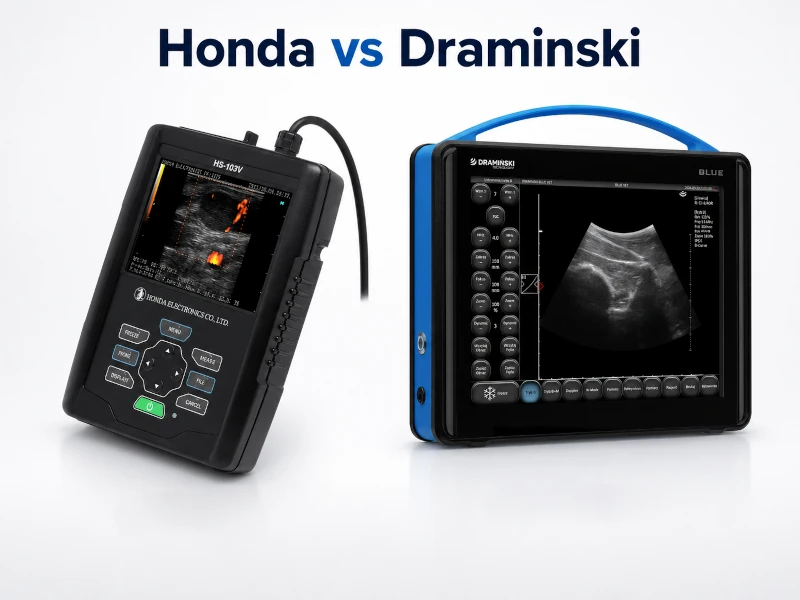
Honda vs Draminski Ultrasound Compared

Summary

Honda and Draminski are both commonly considered for portable veterinary ultrasound, but they appeal to slightly different buyers. Honda may suit vets looking for compact, practical veterinary ultrasound models, while Draminski may appeal to buyers who want a broader veterinary-focused portable range for equine, farm, small animal, and field use.

Introduction

Honda vs Draminski is not a simple “which brand is better?” comparison. Both brands may be relevant for portable veterinary imaging, but the better choice depends on the animals scanned, the exam type, the probe package, battery needs, service support, and whether the system will be used mostly in a clinic, stable, farm, or mobile setting.

Honda veterinary ultrasound systems include models such as the HS-1600V, HS-2200V, and HS-2700V in Honda Electronics’ veterinary product lineup.  Draminski’s veterinary ultrasound range includes systems such as BLUE, 4Vet Slim, and iScan, with a strong focus on veterinary imaging for small animals, horses, farm animals, and field use. 

This comparison looks at where Honda and Draminski differ in real veterinary use, what each brand may do well, and what buyers should check before choosing one.

Quick Verdict: Which Brand Fits Which Buyer?

Honda may be a good fit for buyers who want a practical portable veterinary ultrasound machine, especially if they are comparing models such as the HS-1600V for field use or the HS-2200V for a larger portable setup. Honda lists the HS-1600V as a compact Doppler-compatible veterinary model, while the HS-2200V is described as a 12.1-inch portable system that combines ultrasound diagnosis functions into one package.

Draminski may be a better fit for buyers who want a veterinary-focused portable brand with systems aimed at small animals, horses, mixed practices, and field conditions. Draminski describes the 4Vet Slim as suitable for small animals, horses, and mixed veterinary practices, while BLUE is positioned as a diagnostic ultrasound scanner with Doppler and high-quality imaging for small animals and horses.

The better option depends less on the logo and more on the exact model, probes, battery condition, image quality, service history, and support.

The Main Difference: Practical Portability vs Veterinary Range

The main difference is how each brand tends to appear in buyer comparisons. Honda often comes up when vets are researching compact, practical veterinary ultrasound units for field or mobile use. Models like the HS-1600V are especially relevant when weight, battery use, outdoor visibility, and simple handling matter.

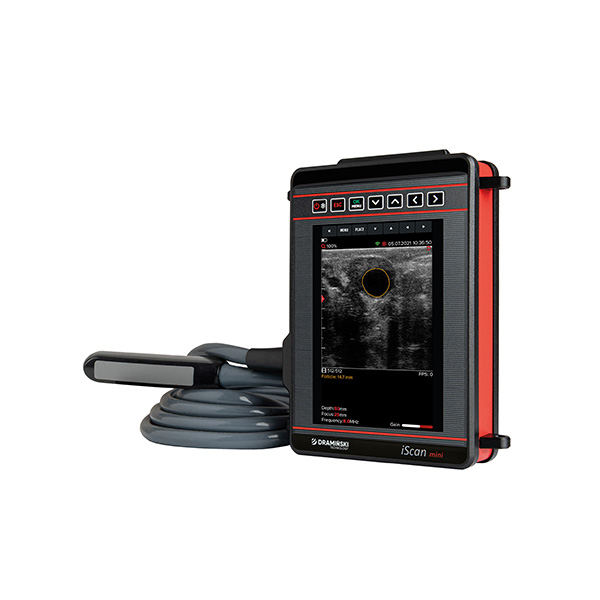
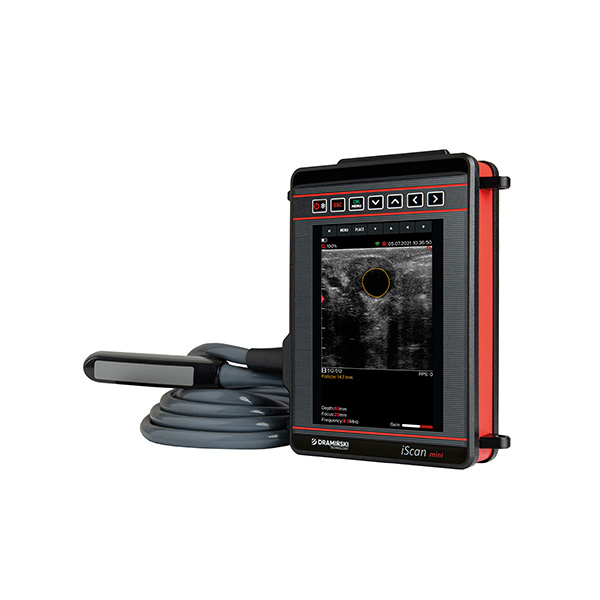
Draminski has a broader veterinary-specific portable identity. Its range includes systems for small animal and horse imaging, mixed-practice use, and field-focused scanning. Draminski also describes iScan as a small, light ultrasound scanner designed for field situations, including reproduction work and equine uses.

In simple terms, Honda may feel more like a compact practical tool, while Draminski may feel more like a wider veterinary portable ecosystem. That does not make one automatically better. It just means the buyer should start with the workflow first.

Where Honda Has the Advantage

Honda may stand out for compact portable models, practical field usability, simple veterinary scanning workflows, battery-powered options, outdoor and mobile use, and selected Doppler-compatible systems.

The Honda HS-1600V is one of Honda’s most visible portable veterinary models.  Honda lists it with a compact body of around 3 kg, AC and battery power, USB image storage, linear and convex probe options, and Doppler functions with compatible probes. It also highlights a high-luminance LCD, wide viewing angle, and portability for house calls and outdoor scanning.

Best Honda Fit

Honda may be a better fit for farm vets needing a compact system, mobile vets who want a lightweight setup, equine or reproductive users comparing portable options, and buyers looking at specific Honda models on the used or refurbished market.

Honda may also suit practices that do not need a high-end cart-based clinic system but still want a practical ultrasound machine for reproductive exams, farm work, equine use, or mixed mobile scanning.

Where Draminski Has the Advantage

Draminski may stand out for its veterinary-specific brand focus, systems for small animals and horses, field-focused scanner options, mixed-practice suitability, practical equine and farm use, and portable workflow across several models.

Draminski states that it has more than 30 years of experience developing veterinary ultrasound equipment. Its veterinary range includes portable systems for both clinic and field use, and it describes its compact handheld scanners as suitable for farm and companion animal vets, including livestock ultrasound, reproduction monitoring, internal organ exams, equine reproductive ultrasound, Ovum Pick-Up procedures, and tendon diagnostics.

Best Draminski Fit

Draminski may be a better fit for equine vets, mixed practices, small animal clinics needing portable imaging, farm and livestock vets, and buyers who want a broader veterinary-specific model range.

It may also suit vets who value field-ready design and veterinary support, especially when scanning happens in barns, stables, farms, mobile visits, or mixed environments rather than only in a fixed clinic room.

Equine, Farm, and Mobile Use

For equine work, Draminski may have an advantage if the buyer wants a veterinary-focused portable system for horse imaging and field use. The BLUE and 4Vet Slim systems are both positioned for small animals and horses, while iScan is field-focused and includes use cases such as cow and mare reproduction and horse tendon imaging.

Honda may still be relevant for equine buyers if the available model and probe package fit the intended exams. For example, the HS-1600V can be considered where compact size, battery use, outdoor screen visibility, and compatible linear or convex probes are priorities.

For farm and livestock work, both brands may be considered. Honda can make sense for practical reproductive or field scanning, while Draminski may appeal to buyers who want systems built around farm, mobile, and veterinary-specific scenarios.

For mobile veterinary services, the comparison should focus on weight, battery health, probe durability, cleaning, screen visibility, startup speed, and how easily the system can be carried and set up between appointments.

Probe Package: The Detail That Decides the Winner

A Honda or Draminski machine is only as useful as the probes included with it. A cheaper system with the wrong probe package may not be a good purchase.

For livestock reproductive scanning, rectal probes may be essential, while linear probes, convex probes, and micro-convex probes may matter more for tendon, abdominal, reproductive, and small animal exams.  For equine tendon work, linear probes are often important. For abdominal and reproductive imaging, convex probes may be needed. For small animal abdominal exams, micro-convex probes can be useful. For blood flow assessment, buyers should confirm Doppler-capable probes and Doppler modes.

This is where buyers should ask a simple question: What do I actually need to scan every week? If the answer is cattle pregnancy checks, the right probe package will look very different than it would for a small animal clinic doing abdominal and soft tissue exams.

Image Quality, Doppler, and Daily Workflow

Buyers should avoid assuming one brand has better image quality across every model. A newer or higher-end Draminski may outperform an older Honda, while a well-maintained Honda with the right probe may be a better value than an under-equipped alternative.

Image quality should be checked with sample scans. Doppler should also be verified because it may not be included or useful on every configuration. Draminski BLUE, for example, lists Color Doppler, Power Doppler, and Pulse Wave Doppler modes, while Honda’s HS-1600V lists Color Flow Mapping and Power Doppler functions with compatible probes.

Battery life matters more for field users than clinic users. Screen visibility matters outdoors. Simple controls may be more useful than advanced features in farm settings. Advanced tools only matter if the practice actually uses them.

Used or Refurbished: Which Brand Is Easier to Buy Safely?

For Honda, buyers should pay close attention to model age, battery condition, screen quality, included probes, Doppler compatibility, and replacement probe availability. Since many buyers may encounter Honda systems used or refurbished, condition and support are especially important.

For Draminski, buyers should check the exact model, probe package, battery condition, software or feature set, service support, and whether parts or probes are available for that model.

For both brands, ask for test images, service history, warranty terms, and a clear return policy before purchase. Probe condition can strongly affect the real value of the system, especially if replacement probes are expensive or difficult to source.

Common Mistakes When Comparing Honda and Draminski

A common mistake is choosing by brand name instead of model. Honda HS-1600V, HS-2200V, Draminski BLUE, 4Vet Slim, and iScan are not interchangeable systems.

Another mistake is ignoring the probe package. The machine may be portable and affordable, but if it does not include the right probe for reproductive, tendon, abdominal, or small animal work, it may not fit the practice.

Buyers should also avoid buying a portable unit without checking battery health, assuming every unit supports Doppler, choosing the lightest system without checking image quality, buying an older system without checking parts availability, skipping test images, or forgetting to compare service and warranty support.

It is also important not to choose a farm-focused scanner for advanced small animal clinic work without checking its limits.

Final Recommendation

Honda may be the better choice if the buyer wants a compact, practical veterinary ultrasound system and has found a well-tested unit with the right probes, battery condition, and support.

Draminski may be the better choice if the buyer wants a broader veterinary-focused portable range, especially for equine, farm, mobile, small animal, or mixed-practice use.

The better choice between Honda and Draminski depends on the exact model, probe package, condition, support, and the animals your practice scans most often.

FAQ

Is Honda better than Draminski for veterinary ultrasound?

Honda is not automatically better than Draminski. Honda may suit buyers looking for a specific compact portable veterinary system, while Draminski may suit buyers wanting a broader veterinary-focused portable range.

Is Draminski better than Honda for equine vets?

Draminski may be a strong choice for equine vets because its range includes veterinary scanners for small animals, horses, and field use. Honda may also work if the model and probe package fit the intended equine exams.

Is Honda ultrasound good for farm vets?

Honda veterinary ultrasound systems may be suitable for farm or reproductive scanning, especially when paired with the right probe. Buyers should check the exact model, battery condition, and probe compatibility.

Which brand is better for mobile veterinarians?

Draminski may offer more veterinary-specific portable options, while Honda may be attractive if a compact model like the HS-1600V fits the workflow. The best choice depends on weight, battery life, probes, and support.

Should I buy a used Honda or Draminski ultrasound machine?

A used Honda or Draminski ultrasound machine can be worth buying if it is tested, includes the right probes, has good battery condition, and comes with warranty or seller support. 

What should I compare before choosing Honda or Draminski?

Compare the exact model, probe package, image quality, Doppler features, battery health, screen condition, service history, warranty, and whether the machine fits farm, equine, small animal, or mixed-practice use.

Mindray vs Draminski Ultrasound Compared


Summary

Summary

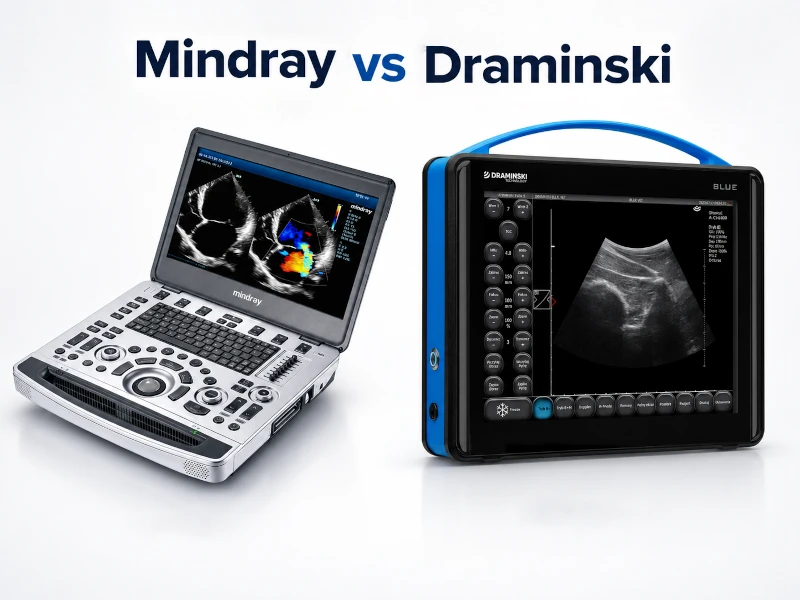
Mindray and Draminski both offer veterinary ultrasound systems, but they often appeal to different buyers. Mindray may suit clinics wanting a broader range of portable and cart-based systems, while Draminski may appeal more to vets who value portable, field-friendly veterinary scanners for horses, farm animals, and mixed practice.

Introduction

Comparing Mindray vs Draminski is not simply about deciding which brand is “better.” The stronger choice depends on the animals treated, where the system will be used, which probes are needed, and whether the buyer values clinic workflow, portability, field durability, or budget.

Mindray veterinary ultrasound systems include both cart-based and portable options designed for image quality, dedicated veterinary presets, and user-friendly workflow.  Its veterinary range includes models such as Vetus E7 and Z60 Vet, along with higher-end Vetus systems for more complete clinic imaging setups. Draminski ultrasound scanners focus strongly on small animals, horses, farm animals, and field use, with systems such as BLUE, 4Vet Slim, and iScan. 

This comparison looks at where each brand fits best, what buyers should compare, and which option may make more sense for different veterinary workflows.

Quick Verdict: Mindray or Draminski?

Mindray may be the better fit for clinics that want a wider range of veterinary ultrasound systems, including cart-based and portable options for small animal, mixed-practice, and general diagnostic imaging. It may also appeal to buyers who want a clinic-friendly workflow, veterinary presets, Doppler options, and a range of models to compare.

Draminski may be the better fit for vets who prioritise portability, field scanning, equine exams, farm work, reproductive imaging, and straightforward veterinary workflow. Draminski’s veterinary ultrasound range includes systems designed for small animals and horses, as well as field-focused scanners for livestock and reproductive work.

This is not a final rule. The specific model, probe package, condition, warranty, and service support matter more than the brand name alone.

Where Mindray Has the Advantage

Mindray’s main advantage is range. The brand offers both cart-based and portable veterinary ultrasound systems, which gives clinics more room to choose based on workflow and budget. A clinic that performs regular small animal ultrasound may prefer a cart-based Vetus system, while a mixed practice may compare portable options such as Vetus E7 or Z60 Vet.

Mindray may also be attractive for buyers who want veterinary presets and a more complete clinic workflow. Mindray describes its veterinary ultrasound category as including cart-based and portable systems designed to support diagnostic confidence with image quality, dedicated veterinary presets, and user-friendly workflow. The Z60 Vet is described as a portable colour Doppler system with dedicated veterinary workflow and support for both large and companion animals.

Best Mindray Fit

Mindray may be a better fit if you need a clinic-friendly system, want both portable and cart-based choices, scan mostly dogs and cats, or need a machine for general diagnostic imaging. It may also suit buyers who want a broader model range, Doppler options, reporting tools, and used or refurbished clinic equipment.

For a small animal clinic, the appeal is flexibility. For a mixed practice, the appeal is the ability to choose a system that can support multiple exam types without being limited to a field-only workflow.

Where Draminski Has the Advantage

Draminski’s advantage is practical veterinary portability. The brand is strongly associated with scanners used in equine, farm, mobile, and mixed-practice environments. Its BLUE scanner is described as a modern ultrasound scanner with Doppler ultrasonography and high-quality imaging for small animals and horses. Its 4Vet Slim is described as a high-quality imaging system for small animals and horses and as a good fit for veterinary mixed practices.

Draminski may appeal to vets who scan outside the clinic, move between locations, or need a system that is easy to set up and carry. Its veterinary ultrasound range also includes iScan, which Draminski describes as a small, light device designed to make field ultrasound more comfortable.

Best Draminski Fit

Draminski may be a better fit for equine vets, farm and livestock vets, mobile veterinarians, and mixed practices needing portability. It may also suit vets who scan in barns, stables, farms, or field conditions, especially for reproductive exams, tendon evaluation, and general portable imaging.

For these users, the buying decision often comes down to battery life, screen visibility, probe handling, durability, and how quickly the system can be used in less controlled environments.

Clinic Imaging vs Field Imaging

The biggest difference between Mindray and Draminski may be the work environment.

For a clinic that performs regular abdominal scans, soft tissue imaging, small animal exams, and possibly cardiac or Doppler work, Mindray may feel more flexible because of its wider system range. A clinic can compare cart-based systems for a dedicated imaging room or portable systems for shared use between rooms.

For a vet who travels between farms, stables, or mobile appointments, Draminski may feel more practical because many of its systems are built around veterinary portability and field usability. Draminski specifically describes portable veterinary ultrasound as useful both in the clinic and in the field, with farm and companion animal applications.

That does not mean Mindray is only for clinics or Draminski is only for field work. Mindray has portable systems, and Draminski has systems suitable for small animal and mixed-practice use. The difference is in the general buying angle: Mindray leans broader, while Draminski leans field-friendly.

Image Quality and Diagnostic Confidence

Both brands can offer useful veterinary image quality, but buyers should avoid judging image quality at brand level only. A higher-end model from either brand may perform very differently from an older, entry-level, or poorly maintained used system.

Mindray may be attractive for buyers who want a broader clinical imaging setup with veterinary workflow and model choice. Draminski may be attractive for buyers who want clear portable imaging in practical veterinary environments. For example, Draminski BLUE includes three Doppler imaging modes: Color Doppler, Power Doppler, and Pulse Wave Doppler. Mindray’s Z60 Vet is also positioned as a portable colour Doppler system with advanced veterinary features.

Instead of asking which brand has better image quality overall, buyers should ask whether the specific machine produces reliable images for the exams they perform every day.

Probe Packages Can Decide the Winner

Mindray vs Draminski often comes down to the probes included with the system. A cheaper machine with the wrong probes may be a worse purchase than a more expensive system that already includes the right setup.

Common probe needs include convex probes, linear probes, and micro-convex probes, along with rectal probes for large animal reproductive work and phased-array probes if cardiac imaging is needed.

Doppler-capable probes also matter where blood flow assessment is important. Draminski’s BLUE and 4Vet Slim product information lists multiple probe options across convex, linear, microconvex, OPU, and rectal styles, depending on configuration. Mindray buyers should similarly confirm whether the system supports the probes needed for companion animal, large animal, cardiac, reproductive, or mixed-practice exams.

Which Brand Fits Which Veterinary Buyer?

Choose Mindray If…

Choose Mindray if you need a clinic-friendly system, want portable and cart-based choices, scan mostly dogs and cats, need a system for general diagnostics, want a broader model range to compare, or are considering used or refurbished clinic equipment.

Mindray may also make sense if your practice wants a system that can support multiple users, exam presets, Doppler options, and more complete imaging workflow.

Choose Draminski If…

Choose Draminski if you need strong portability, work with horses, livestock, or mixed species, scan outside the clinic often, value simple field workflow, need a practical system for reproductive or tendon exams, or want a veterinary-focused portable scanner.

Draminski may also be suitable if your practice needs a system that can move between clinic rooms, farms, stables, and mobile appointments without feeling like a full cart-based setup.

New, Used, or Refurbished: Which Brand Is Safer to Buy?

Either brand can be a good option when comparing used portable ultrasound machines, as long as the system is properly tested and supported. 

For Mindray, buyers should check model year, installed software, veterinary presets, Doppler features, probe compatibility, and whether the system fits the clinic’s imaging needs. A used Mindray cart-based system may be a good value for a clinic, but only if the probes, software, and service options are still suitable.

For Draminski, buyers should pay special attention to battery condition, screen condition, probe wear, portability accessories, and whether replacement probes or parts are available. This is especially important for systems that will be used in field or mobile settings.

For both brands, probe condition can strongly affect the real value of the purchase. A low-cost machine with worn or unsuitable probes can quickly become expensive.

Common Mistakes When Comparing Mindray and Draminski

A common mistake is comparing brand names instead of specific models. Mindray and Draminski both offer different systems, so the exact machine matters.

Another mistake is ignoring probe compatibility. The system must include or support the probes needed for abdominal, reproductive, tendon, cardiac, or soft tissue imaging.

Buyers also make mistakes when they choose by price alone, buy a portable system without checking battery health, assume every system includes Doppler, or fail to confirm warranty and service support.

It is also important not to buy a clinic-focused system for heavy field work or a field-focused system for advanced clinic imaging without checking limitations first. A good purchase should match the exam type, species, and work environment.

Final Recommendation

Mindray and Draminski are both valid veterinary ultrasound choices, but they suit different buyer profiles.

Mindray may be the stronger choice for clinics that want a broader ultrasound platform for small animal and mixed-practice imaging. It may appeal to buyers who want cart-based and portable choices, veterinary presets, Doppler options, and a clinic-friendly workflow.

Draminski may be the better fit for veterinarians who need practical portability, equine and farm usability, and field-friendly scanning. It may appeal to mobile vets, livestock vets, equine vets, and mixed practices where simple handling and flexible use matter.

The best decision comes down to the model, probes, condition, support, and the exams your practice performs most often.

FAQ

Is Mindray better than Draminski for veterinary ultrasound?

Mindray is not automatically better than Draminski. Mindray may be better for clinics that want a broader range of cart-based and portable ultrasound systems, while Draminski may be better for portable, equine, farm, and field-focused veterinary use.

Is Draminski better than Mindray for equine vets?

Draminski may be a strong option for equine vets because its veterinary ultrasound range includes systems designed for small animals and horses, with portable use in mind. The best choice still depends on the probe package, image quality, battery life, and support.

Is Mindray good for small animal clinics?

Yes, Mindray may be a good fit for small animal clinics and mixed practices, especially buyers who want a wider choice of veterinary ultrasound systems, including portable and cart-based options.

Which brand is better for farm vets?

Draminski may often be more relevant for farm vets because of its portable veterinary scanner focus, but some Mindray portable systems may also be suitable depending on probes and workflow.

Which brand is better for used ultrasound buyers?

Either brand can be a good used purchase if the system is tested and supported. Buyers should check probe condition, software options, service history, battery health for portable units, and warranty before buying.

What should I compare before choosing Mindray or Draminski?

Compare the exact model, included probes, image quality, Doppler features, portability, battery life, service support, warranty, and whether the system fits small animal, equine, livestock, or mixed-practice use.

Best Equine Ultrasound Machines for Vets

Summary

The best equine ultrasound machine depends on how the vet works: reproductive scanning, tendon and ligament exams, field visits, sports horse care, or clinic-based diagnostics. Buyers should compare portability, probe options, battery life, image quality, durability, Doppler features, and service support before choosing a new, used, or refurbished system.

Introduction

Equine ultrasound has a different set of demands compared with standard small animal scanning. Horses are often scanned in barns, stables, farms, breeding facilities, or performance settings, so the machine needs to be practical outside a controlled exam room.

For equine vets, portability is not just a convenience. It can affect how quickly the exam starts, how comfortable the scan is, how clearly the screen can be viewed, and whether the system can handle repeated use in real field conditions. A clinic-based equine practice may have different needs from a mobile reproductive vet or a sports horse veterinarian.

Brands such as Draminski, Esaote, IMV Imaging, and Mindray all offer veterinary or equine-focused ultrasound options. Draminski highlights equine uses such as reproductive ultrasound, Ovum Pick-Up procedures, and tendon diagnostics, while Esaote describes equine ultrasound as useful for diagnosing injuries, managing recovery plans, monitoring pregnancy, and assessing the reproductive tract. IMV Imaging offers veterinary ultrasound scanners for small animal, equine, and farm markets, and Mindray lists Vetus EQ as focused on equine ultrasound diagnosis demand.

Quick Verdict: What Makes a Good Equine Ultrasound Machine?

A good equine ultrasound machine should be portable enough for real field use, durable enough for barn conditions, and flexible enough to support the most common equine exams. For many vets, the best machine is not the most advanced system overall. It is the one that handles daily equine work reliably.

For most equine buyers, the main priorities are strong image quality for tendons and reproductive exams, linear and rectal probe options, good battery life, a screen that can be used in bright conditions, simple controls for field scanning, durable probe cables, and access to service support or replacement probes.

A referral hospital may need a more advanced system with better Doppler, documentation, and imaging tools. A mobile reproductive vet may be better served by a rugged portable system that starts quickly, scans reliably, and is easy to clean between calls.

Start With the Type of Equine Work You Do

Reproductive and Breeding Work

Equine vets who focus on breeding management, pregnancy checks, follicle monitoring, and reproductive tract exams need a system that supports suitable rectal or reproductive probes. During breeding season, these exams may be repeated often, so speed, comfort, and consistency matter.

For this work, the best machine should make routine reproductive exams efficient. Image clarity is important, but so are probe handling, battery life, and a setup that does not slow the vet down during a busy day of farm or stable visits.

Tendon and Ligament Exams

Sports horse and lameness work often requires detailed imaging of superficial structures. A high-frequency linear probe is usually important for tendon, ligament, and soft tissue evaluation because these structures sit close to the surface.

For tendon work, near-field detail may matter more than deep penetration. A system that performs well for abdominal imaging may not automatically be the best choice for tendon exams if the linear probe quality is poor or the image detail is not sharp enough.

Mobile and Field Practice

Field vets need different priorities from a referral hospital. Battery life, portability, screen visibility, durability, cleaning, and transport protection may matter more than advanced software features.

A mobile equine ultrasound machine should be practical to carry, quick to turn on, stable during scanning, and able to handle repeated movement between vehicles, barns, stables, and outdoor environments.

Advanced Equine Diagnostics

Referral or specialty practices may need stronger Doppler, advanced imaging tools, guided-procedure capability, or a more complete clinic-based system. These systems may be less convenient for field use, but they can provide better ergonomics, larger displays, and more complete documentation.

Brands Equine Vets Often Compare

Draminski equine ultrasound systems may be a strong option for vets who want portable veterinary ultrasound systems built around field use, small animal, horse, and mixed-practice imaging. Its veterinary range includes BLUE and 4Vet Slim, and the company specifically notes equine applications such as reproductive ultrasound, Ovum Pick-Up procedures, and tendon diagnostics.

IMV Imaging may suit equine and mixed-practice vets who value veterinary imaging support, training, and a broad equipment range. IMV says it offers veterinary ultrasound scanners for small animal, equine, and farm markets, which makes the brand relevant for vets who work across multiple species.

Esaote may be better suited for equine practices that want higher-end veterinary imaging, sports horse diagnostics, reproductive monitoring, and follow-up care. Esaote’s equine ultrasound page describes ultrasound as valuable for diagnosing pathologies and injuries, managing recovery plans, and monitoring pregnancy and reproductive health.

Mindray may be relevant for equine vets or mixed practices comparing dedicated veterinary systems with equine presets and broader clinic functionality. Mindray lists Vetus EQ as focused on equine ultrasound diagnosis demand, with professional presets for different application scenarios.

The Probe Package Matters More Than the Machine Name

Equine vets should not buy based only on brand or model. The machine needs the right probes for the work. A system with the wrong probe package may not support the exams your practice performs every week.

Linear probes, convex probes, and micro-convex probes may all matter in equine or mixed-practice imaging, with linear probes commonly used for tendons, ligaments, superficial soft tissue, and some vascular work.  Rectal probes are important for reproductive exams and breeding work. Convex probes may be useful for deeper abdominal or general imaging needs. Micro-convex probes can be helpful for mixed-practice use or smaller patients. Doppler-capable probes may matter when blood flow assessment is part of the workflow.

A used equine ultrasound system with the wrong probe package may cost more in the long run than a slightly more expensive system that already includes the correct probes.

Portable vs Clinic-Based Equine Ultrasound

A portable equine ultrasound machine is usually better for vets who travel to barns, farms, stables, or breeding facilities. It should be light enough to carry, quick to start, easy to clean, and reliable on battery power.

A clinic-based or higher-end system may make more sense for referral hospitals, sports horse centers, or practices that perform detailed diagnostics in a controlled environment. These systems may offer better display size, ergonomics, Doppler tools, and image optimization, but they may be less practical for everyday field work.

The best equine ultrasound machine is the one that matches where the scan actually happens. A system used mostly in a stable should be judged differently from one used in a dedicated imaging room.

What Equine Vets Should Review Before Buying

Before buying an equine ultrasound machine, ask:

  • Will the machine be used mostly in the field or clinic?
  • Which exams will be performed most often?
  • Are the right equine probes included?
  • How long does the battery hold charge?
  • Is the screen visible in bright barns or outdoor light?
  • Is the system easy to clean between calls?
  • Are probe cables durable enough for field use?
  • Are test images available?
  • Is service support available?
  • Are replacement probes and parts easy to source?

These questions help separate a system that looks good on paper from one that will actually work in daily equine practice.

Where Higher-End Equine Ultrasound Is Worth It

Not every equine vet needs a premium ultrasound machine. However, a higher-end system may be worth considering for sports horse medicine, tendon and ligament follow-up, referral imaging, advanced reproductive work, guided procedures, Doppler-based assessments, high-volume equine scanning, or clinics that need stronger documentation and image storage.

A high-end system is only worth the cost if the practice will use the features regularly. For occasional reproductive checks, a simpler portable machine may be enough. For advanced sports horse diagnostics or referral imaging, better image detail, Doppler, display quality, and reporting tools may justify the investment.

Buying Used or Refurbished Equine Ultrasound Machines

Used and refurbished ultrasound machines can be a smart option for equine vets, especially when the system is properly tested and includes the right probes.  This can allow a practice to access better imaging capability at a lower upfront cost.

Buyers should check the exact model and age, included probe types, probe cable and lens condition, battery health, screen condition, Doppler features if needed, test images, service history, warranty or return option, and replacement probe availability.

For equine vets, battery health and probe condition are especially important because field use can be hard on equipment. A low-cost system may not be a good value if the battery fails quickly or the probe needs repair soon after purchase.

Common Mistakes Equine Vets Should Avoid

One common mistake is buying a machine before choosing the probe package. The system may be portable and affordable, but it will not be useful if it cannot support reproductive, tendon, or general equine exams.

Other mistakes include choosing only by brand name, buying the lightest system without checking image quality, ignoring battery condition, assuming every portable unit is field-ready, forgetting screen visibility in barns or sunlight, buying without test images, choosing a small animal system that does not fit equine workflow, and ignoring service or replacement probe availability.

The right purchase should match the species, exam type, work environment, and support needs of the practice.

Final Buying Advice

The best equine ultrasound machine depends on the vet’s real workflow. A reproduction-focused field vet may need a rugged portable system with strong battery life and a rectal probe, while a sports horse or referral practice may need better image detail, linear probe performance, Doppler, and documentation tools.

The best equine ultrasound machine is the one that fits your daily scanning environment, supports the right probes, produces reliable images, and can be serviced when your practice depends on it.

FAQ

What is the best ultrasound machine for equine vets?

There is no single best machine for every equine vet. The best choice depends on whether the system will be used for reproduction, tendon exams, field calls, sports horse diagnostics, or clinic-based imaging.

What probes do equine vets need?

Many equine vets need a rectal probe for reproductive work and a high-frequency linear probe for tendon, ligament, and superficial soft tissue exams. Some practices may also need convex or Doppler-capable probes.

Is portable ultrasound good for equine practice?

Yes, portable ultrasound is often very useful for equine practice because many horses are scanned in barns, farms, stables, and breeding facilities. Battery life, durability, screen visibility, and probe quality are important.

Which brands make equine ultrasound machines?

Common brands considered by equine vets include Draminski, IMV Imaging, Esaote, Mindray, and selected systems from other medical imaging brands depending on the use case and supplier support.

Is Draminski good for equine ultrasound?

Draminski may be a strong option for equine ultrasound, especially for portable and field-focused use. The brand highlights equine applications including reproductive work, Ovum Pick-Up procedures, and tendon diagnostics.

Is Mindray suitable for equine vets?

Mindray may be suitable for equine or mixed-practice vets depending on the model and probes. Mindray lists Vetus EQ as focused on equine ultrasound diagnosis needs, with presets for different application scenarios.

Should equine vets buy used ultrasound equipment?

Used or refurbished equipment can be worth buying if the machine, probes, battery, screen, and software have been tested. Warranty, service support, and replacement probe availability should also be checked.

Best Ultrasound Machines for Small Animal Vets

Summary

The best ultrasound machine for small animal vets depends on image quality, probe options, Doppler features, workflow, budget, and service support. Dogs and cats often require abdominal, cardiac, soft tissue, reproductive, and guided-procedure imaging, so the right machine should match the clinic’s most common exams.

Introduction

Small animal vets do not all need the same ultrasound machine. A general practice may need a dependable system for abdominal scans, bladder checks, pregnancy confirmation, and soft tissue evaluation. A referral clinic may need stronger Doppler, cardiac tools, high-frequency probes, advanced imaging features, and better workflow for repeat exams.

Brands such as Mindray, Esaote, GE, Draminski, and Canon may all be considered depending on the clinic’s needs. Mindray offers dedicated veterinary ultrasound systems with both cart-based and portable options. Esaote lists veterinary systems for applications including small animal abdominal, MSK, and cardiology work. GE has a veterinary ultrasound portfolio that includes LOGIQ, Versana, VIVID, and portable solutions, while Draminski offers scanners for small animals and horses.

This guide explains what small animal vets should look for, which types of machines make sense, and how to approach choosing a system that fits daily clinic use.

Quick Buying Verdict

For most small animal clinics, the best ultrasound machine is not simply the most expensive system. It is the machine that gives clear abdominal images, supports the right probes, has an easy workflow, and can be serviced when needed.

A small animal vet should usually prioritise strong abdominal imaging, micro-convex and linear probe options, Doppler if cardiac or advanced work is needed, simple controls for daily use, reliable service support, and good probe condition if buying used or refurbished.

A premium system may be worth it for specialty clinics, but many general practices may be better served by a reliable mid-range veterinary system with the right probes. A clinic that mostly performs bladder checks and routine abdominal scans may not need the same machine as a referral hospital doing cardiac exams, exotic animal imaging, or guided biopsies.

What Small Animal Vets Actually Need From Ultrasound

Small animal ultrasound is usually about answering practical diagnostic questions quickly and consistently. Dogs and cats may be scanned for vomiting, abdominal pain, bladder or urinary concerns, liver, kidney, spleen, intestinal changes, pregnancy checks, masses, fluid buildup, soft tissue swelling, and guided biopsies or fluid sampling.

Some clinics also perform echocardiography, which requires a different level of probe support, Doppler performance, and user skill. Others may only need general abdominal imaging and a simple workflow that multiple vets can use.

A small animal ultrasound machine should help the vet answer everyday diagnostic questions clearly, without slowing down the clinic. That means image quality matters, but so do probe handling, exam presets, image saving, cleaning, and service support.

The Three Machine Types Small Animal Vets Compare

Portable Veterinary Ultrasound Systems

Portable systems are useful for clinics with limited space, mobile vets, or practices that move the machine between exam rooms. They can be a good fit for general abdominal imaging, soft tissue exams, bladder checks, and basic reproductive work.

Portable does not always mean basic. Some portable systems now offer strong imaging and Doppler features. However, buyers should compare screen size, probe compatibility, battery health, durability, and service support before choosing one. A portable system is only practical if it produces the images the clinic needs and can handle daily use.

Cart-Based Clinic Systems

Cart-based systems often make sense for clinics that scan frequently. They usually offer a larger screen, more stable workflow, better ergonomics, and easier use in a dedicated imaging room.

This type of machine may be a better fit for busy small animal clinics, multi-vet practices, regular abdominal ultrasound, and clinics that want stronger display quality and more comfortable scanning sessions. A cart-based system may also be easier to share between users because probes, controls, and accessories can stay organised in one place.

Advanced or Specialty Ultrasound Systems

Referral hospitals and specialty clinics may need more advanced systems for cardiology, exotic animal imaging, detailed abdominal work, soft tissue assessment, or guided procedures.

This is where brands such as Canon, GE, or higher-end veterinary systems may be considered. Canon has published an example of Aplio i800 use in exotic animal care, including abdominal and thoracic exams, ultrasound-guided biopsies, nerve blocks, and echocardiography. These systems may be more than a general practice needs, but they can be valuable when the clinic performs advanced imaging often.

The Best Probe Setup for Small Animal Vets

The probe package often matters more than the machine name. A strong ultrasound system with the wrong probes may not fit a small animal clinic at all.

A micro-convex probe is often useful for dog and cat abdominal exams because it can work well in smaller spaces and around curved anatomy. A linear probe is useful for superficial structures, vessels, soft tissue, tendons, and small parts. A convex probe may be useful for deeper abdominal imaging and larger dogs. A phased-array probe is important if the clinic performs cardiac ultrasound. A high-frequency probe can be useful for small patients, superficial anatomy, and exotic animals.

This is especially important when buying used or refurbished. A low-priced machine with damaged, missing, or mismatched probes can become expensive quickly.

Best-Fit Brands for Small Animal Clinics

Mindray veterinary ultrasound systems may be a strong fit for small animal and mixed practices because they include Vetus models built for animal imaging workflows. Mindray describes its veterinary ultrasound solutions as cart-based and portable systems designed for image quality, dedicated veterinary parameters, and user-friendly workflow.

Esaote may suit clinics that want veterinary-focused imaging with strong small animal, cardiology, musculoskeletal, and reproductive capabilities. Esaote’s MyLab EightVET page specifically references small animal abdominal, MSK, and cardiology applications, along with veterinary measurement packages.

GE may be worth considering for clinics that want broader medical imaging capability, especially advanced abdominal imaging, cardiovascular ultrasound, guided procedures, or premium refurbished systems. GE’s veterinary ultrasound portfolio includes LOGIQ, Versana, VIVID, and portable solutions for veterinary applications.

Draminski may fit clinics that want portable veterinary ultrasound for small animals and horses, especially when mobility and mixed-practice use matter. Draminski describes its small animal ultrasound machines as useful for point-of-care procedures such as AFAST and TFAST, as well as routine abdominal organ exams.

Canon may be more relevant for advanced small animal, referral, cardiac, or exotic animal imaging rather than basic first-system purchases. It may be especially interesting when a clinic needs high-resolution imaging, high-frequency probes, or specialist diagnostic capability.

What Makes a Machine Good for Dogs and Cats?

A good small animal ultrasound machine should provide clear abdominal image quality, good near-field detail, reliable Doppler if needed, comfortable probe handling, easy preset selection, fast image saving, simple cleaning between patients, good monitor visibility, and smooth workflow for repeat exams.

Image quality should be judged from test images on the exact machine, not only from brand reputation. A newer mid-range veterinary system with the right probes may be more useful than an older premium machine that lacks the correct software or transducers.

When to Choose a Higher-End System

A higher-end machine may be worth it if the clinic regularly performs echocardiography, advanced abdominal scans, referral imaging, guided biopsies, complex soft tissue exams, exotic animal imaging, or high-volume ultrasound appointments.

For a general clinic that only performs occasional bladder checks, pregnancy checks, or basic abdominal scans, a mid-range veterinary ultrasound system may be more practical. The goal is not to buy the most advanced machine available. The goal is to buy the system that supports the clinic’s real case mix.

Buying Used or Refurbished for a Small Animal Clinic

Used or refurbished ultrasound machines can be a good option for small animal vets if they are properly tested.  This can allow a clinic to access better image quality or stronger features at a lower upfront cost.

Before buying, check the exact model and year, included probes, probe condition, sample images, software options, Doppler features, cardiac package if needed, service history, warranty or return policy, parts availability, and whether the machine fits daily small animal workflow.

A low-cost used system may not be a bargain if the probe is damaged, the software is limited, or the machine cannot be serviced easily.

Common Mistakes Small Animal Vets Should Avoid

Avoid buying based only on brand name. A good brand does not guarantee that the specific model, probe package, or software configuration fits your clinic.

Other common mistakes include choosing the cheapest system available, ignoring probe compatibility, buying without sample images, assuming every system supports Doppler, choosing a field scanner for advanced clinic imaging, buying a premium system without the training to use it, forgetting future probe repair costs, and overbuying features the clinic will rarely use.

The best purchase should match the exams performed every week, not just the features listed on a brochure.

Final Buying Advice

The best ultrasound machine for small animal vets should match the practice’s real case mix. A general clinic may need a dependable system for abdominal and soft tissue imaging, while a specialty clinic may need stronger Doppler, cardiac tools, advanced workflow, and high-frequency probes.

The best ultrasound machine for a small animal vet is the one that produces reliable images for everyday dog and cat exams, supports the right probes, fits the clinic workflow, and can be maintained long after purchase.

FAQ

What is the best ultrasound machine for small animal vets?

There is no single best ultrasound machine for every small animal vet. The best choice depends on the clinic’s exam types, budget, probe needs, Doppler requirements, workflow, and service support.

What probes do small animal vets need?

Many small animal vets use micro-convex, linear, convex, and phased-array probes for abdominal exams, superficial structures, soft tissue, deeper imaging, and cardiac exams. 

Is portable ultrasound good for small animal vets?

Yes, portable ultrasound can be a good option for small animal vets, especially clinics with limited space or practices that move equipment between rooms. Buyers should still check image quality, probe options, Doppler features, and support.

Should small animal vets buy new or used ultrasound equipment?

Both can make sense. New systems may offer the latest warranty and features, while used or refurbished systems can reduce cost if they are properly tested and include suitable probes.

Is Doppler necessary for small animal ultrasound?

Doppler is not always necessary for basic abdominal exams, but it can be important for cardiac, vascular, reproductive, and more advanced diagnostic work.

What brands are good for small animal veterinary ultrasound?

Mindray, Esaote, GE, Draminski, Canon, and other brands may be suitable depending on the clinic’s needs. The specific model, probe package, condition, and support matter more than the brand name alone.

What should I check before buying a used small animal ultrasound machine?

Check the machine model, included probes, probe condition, image quality, software options, Doppler features, service history, warranty, and availability of replacement probes or parts.

30August 2026

Best Portable Ultrasound Machines for Mobile Vets

Draminski iScan mini – Compact Veterinary Ultrasound

Summary

The best portable ultrasound machine for mobile vets depends on where they scan, which animals they treat, and what exams they perform most often. Buyers should compare image quality, battery life, probe options, weight, durability, screen visibility, Doppler features, cleaning, and service support before choosing a new, used, or refurbished system. 

Introduction

Mobile vets need more from an ultrasound machine than basic portability. The system may need to work in homes, vans, barns, stables, farms, shelters, and small treatment rooms where space, lighting, power access, and patient handling are not always predictable.

That means a portable ultrasound machine should not just be small.  It should be easy to carry, quick to start, durable enough for travel, simple to clean, and compatible with the probes needed for daily mobile work.

Brands such as Mindray, Draminski, Esaote, and IMV Imaging all offer portable or veterinary-focused ultrasound options. Mindray lists the Vetus E7 as a hand-carried veterinary ultrasound system. Draminski offers portable scanners for small animals and horses, as well as wireless probes that can connect to mobile devices or goggles. Esaote offers portable veterinary systems such as MyLab OmegaVET and MyLab X1 Go VET, while IMV Imaging supplies ultrasound scanners for small animal, equine, and farm markets.

This guide explains what mobile vets should look for, which machine styles make sense, and how to choose a system that is practical outside a fixed clinic.

Quick Verdict: What Mobile Vets Should Prioritize

For mobile vets, the best portable ultrasound machine is not always the smallest one. It is the system that gives reliable images, supports the right probes, starts quickly, travels safely, and can handle daily use away from a controlled clinic environment.

The main priorities should be lightweight design without sacrificing image quality, strong battery life, fast startup, easy probe changes, good screen visibility, durable cables and connectors, easy cleaning between patients, reliable service support, and a carrying case or transport setup.

A portable ultrasound machine should make mobile work easier, not add another fragile piece of equipment to worry about. A system that looks impressive in a clinic may not be the best option if it is difficult to transport, slow to set up, or hard to use in bright barns, tight rooms, or field conditions.

Start With Your Mobile Workflow

House-Call Small Animal Vets

House-call small animal vets may need a compact system for abdominal checks, bladder evaluation, pregnancy confirmation, soft tissue concerns, and basic guided procedures. These exams may happen in a living room, treatment van, shelter room, or small workspace.

For this type of mobile work, quiet operation, quick setup, and easy cleaning matter. The system should also be simple enough to use without a full clinic team helping with positioning, cables, and patient handling.

Equine and Stable-Side Vets

Equine vets may need ultrasound for reproductive work, tendon and ligament exams, soft tissue swelling, and follow-up injury checks. In this setting, portability is only one part of the decision.

Battery life, linear and rectal probe options, screen visibility in barns, durable probe cables, and easy carrying between locations are all important. A system used for stable-side exams should be judged by how it performs in real equine environments, not only by its brochure specifications.

Farm and Livestock Mobile Vets

Farm vets may use portable ultrasound for pregnancy checks, reproductive management, fertility work, and herd planning. High-volume scanning requires a machine that is fast, durable, and practical in chutes, barns, and outdoor environments.

For livestock work, the probe package and battery performance may matter more than advanced software. A machine that is easy to clean, easy to carry, and reliable through a long farm visit is often more useful than a system with features the vet rarely uses.

Mixed-Practice Mobile Vets

Mixed-practice mobile vets need the most flexibility. They may scan dogs and cats in the morning, horses in the afternoon, and cattle or goats on another call.

For these buyers, the key is choosing a system with the right probe package, not just a good machine body. One portable ultrasound unit may be suitable for mixed work only if it supports the transducers needed across small animal, equine, and livestock exams.

Portable Does Not Mean One Type of Machine

Laptop-Style Portable Systems

Laptop-style portable systems are usually a strong fit for mobile vets who want a balance of image quality, screen size, and familiar controls. They may be useful for small animal, equine, and mixed-practice work.

These systems are often better for vets who need more than a basic handheld scanner. They can offer a more complete interface, broader probe options, and better display size, while still being portable enough for mobile clinics, house calls, and flexible practice settings.

Handheld and Wireless Ultrasound

Handheld or wireless probes can be useful for quick checks, tight spaces, and vets who need maximum mobility. They can also reduce the amount of equipment carried between locations.

However, buyers should compare image quality, battery life, app workflow, data storage, probe options, and whether the system is suitable for their clinical needs. Draminski, for example, describes wireless veterinary probes that connect to mobile devices and support mobile image storage through its app workflow.

Compact Premium Portable Systems

Compact premium portable systems may be better for vets who need stronger imaging performance but still want portability. Esaote positions MyLab OmegaVET as a premium portable veterinary scanner designed to be easy to carry and support high diagnostic efficiency.

These systems may be a better fit for mobile specialists, advanced small animal imaging, equine diagnostics, or clinics that want portable performance closer to a larger system.

Brands Mobile Vets Often Compare

Mindray portable veterinary systems may suit mobile vets who want a dedicated veterinary portable system with a familiar ultrasound workflow. Its Vetus E7 is listed as a hand-carried veterinary ultrasound system, making it relevant for mobile and flexible veterinary settings.

Draminski portable veterinary ultrasound systems may be a strong fit for vets who need field-friendly veterinary ultrasound. Draminski says its veterinary range includes scanners for small animals and horses, and also offers wireless probes that connect to mobile devices or goggles for greater mobility.

Esaote may suit mobile vets who want higher-end portable imaging. Esaote lists portable veterinary systems including MyLab OmegaVET and MyLab X1 Go VET, with MyLab X1 Go VET described as an ultra-slim system for fast, reliable, mobile veterinary diagnostics.

IMV Imaging may be useful for mobile vets who work across small animal, equine, and farm markets. IMV Imaging describes its veterinary ultrasound range as covering small animal, equine, and farm needs.

The Probe Package Is More Important Than the Logo

A mobile vet can buy a good portable machine and still be disappointed if the probes do not fit daily work. The machine body matters, but the transducers decide what the vet can actually scan.

Micro-convex, linear, convex, and rectal probes can all matter for mobile vets, depending on whether they scan small animals, tendons, deeper anatomy, equine patients, or livestock. A linear probe is useful for tendons, superficial tissues, vessels, and soft tissue masses. A convex probe can help with deeper abdominal or reproductive exams. A rectal probe is important for equine or livestock reproductive work. A phased-array probe is needed if cardiac exams are part of the service. Doppler-capable probes may be useful for blood flow, cardiac, vascular, and some reproductive evaluations.

A used portable ultrasound machine with weak probes, damaged cables, or limited compatibility may cost more long-term than a better-tested system with the right probe setup.

Review the Machine Like Travel Equipment

A mobile ultrasound machine should be judged by how it performs during a real workday, not only by its imaging specifications.

Ask how easy it is to carry, whether it fits safely in a vehicle, how quickly it starts, and whether the battery lasts between calls. Check whether the screen can be seen in bright or awkward lighting, whether the controls are simple when working alone, and whether cables are protected during travel.

Cleaning also matters. A mobile system may move between homes, barns, farms, shelters, and clinics in the same day, so the machine and probes should be easy to disinfect. Image saving and export should also be simple, especially when records need to be shared with a clinic or client.

For mobile vets, reliability between appointments can matter just as much as image quality during the scan.

When a Higher-End Portable System Is Worth It

Not every mobile vet needs a premium system. However, higher-end portable ultrasound may be worth the investment if the practice offers advanced abdominal imaging, echocardiography, equine tendon and ligament exams, reproductive services, guided procedures, exotic animal imaging, high-volume ultrasound appointments, or specialist mobile imaging.

Advanced features only matter when they are used regularly. A vet performing mostly basic bladder checks or pregnancy confirmations may not need the same system as a mobile specialist performing advanced cardiac or abdominal exams.

Buying Used or Refurbished Portable Ultrasound

Used or refurbished portable ultrasound machines can be a smart option for mobile vets, but they need careful checking.  Portable units often experience more movement, transport, battery wear, and cable stress than clinic-only systems.

Buyers should check the exact model and age, included probes, probe lens condition, cable wear, connector condition, battery health, charger and accessories, screen condition, image quality, Doppler and software options, service history, warranty or return policy, and availability of replacement probes and parts.

A low purchase price is not always a good deal if the battery is weak, the probe is damaged, or the system cannot be serviced easily.

Common Mistakes Mobile Vets Should Avoid

Common mistakes include choosing the smallest machine without checking image quality, buying before confirming probe needs, forgetting battery health, assuming every portable system includes Doppler, ignoring screen visibility outdoors, and buying without test images.

Other mistakes include not checking transport protection, choosing a field scanner for advanced clinic-style imaging, choosing a premium system without needing its advanced features, and forgetting service, repair, and replacement probe availability.

The best purchase is the one that supports the mobile vet’s real cases, not just the one with the most attractive size or price.

Final Buying Advice

The best portable ultrasound machine for mobile vets depends on the animals treated, the scan environment, and the services offered. A house-call small animal vet may need a different setup from an equine vet, livestock vet, or mixed-practice mobile service.

The best portable ultrasound machine for a mobile vet is one that travels well, scans reliably, supports the right probes, fits the daily workflow, and can be serviced when the practice depends on it.

FAQ

What is the best portable ultrasound machine for mobile vets?

There is no single best portable ultrasound machine for every mobile vet. The best choice depends on the animals scanned, exam types, probe needs, battery life, image quality, budget, and service support.

What should mobile vets look for in a portable ultrasound machine?

Mobile vets should look for good image quality, long battery life, suitable probes, durable cables, easy cleaning, screen visibility, fast startup, transport protection, and reliable service support.

Are handheld ultrasound machines good for mobile vets?

Handheld ultrasound machines can be useful for quick checks and highly mobile work, but buyers should compare image quality, probe options, battery life, data storage, and whether the system is suitable for their clinical needs.

What probes do mobile vets need?

Many mobile vets need a micro-convex probe for small animal abdominal exams, a linear probe for superficial structures and tendons, a convex probe for deeper imaging, and a rectal probe for equine or livestock reproductive work.

Is Doppler necessary for mobile veterinary ultrasound?

Doppler is not always necessary for basic abdominal or pregnancy checks, but it can be important for cardiac, vascular, reproductive, and more advanced diagnostic work.

Is a used portable ultrasound machine worth buying?

Yes, a used portable ultrasound machine can be worth buying if it has been tested and includes suitable probes, strong battery health, working software, clear image quality, and reliable seller support.

Which brands make portable ultrasound machines for mobile vets?

Brands mobile vets may compare include Mindray, Draminski, Esaote, IMV Imaging, SonoSite, Honda, GE, and others. The best choice depends on the exact model, probe package, condition, and support.

Farm Animal Ultrasound Machines: Buyer’s Guide

Summary

Farm animal ultrasound machines are mainly used for pregnancy diagnosis, reproductive management, fertility work, and selected health evaluations in livestock. Buyers should compare portability, battery life, probe options, durability, image quality, ease of cleaning, service support, and whether the system is practical for daily field use.

Introduction

Farm animal ultrasound is different from standard clinic-based imaging. The machine often needs to work in barns, chutes, pens, farms, and outdoor environments where space, light, weather, animal movement, and speed all matter.

Farm-focused ultrasound systems are commonly used for cattle, sheep, goats, pigs, alpacas, llamas, and other livestock. For farm vets and producers, the goal is not always to buy the most advanced ultrasound system available. It is to choose a machine that can handle daily livestock work without slowing down the workflow.

Brands such as IMV Imaging, Draminski, Mindray, and Honda are often considered for farm or livestock ultrasound. IMV Imaging says it has farm ultrasound systems and tools for livestock scanning, including app-based image viewing and measurement features. Draminski describes its veterinary scanners as suitable for clinic and field use, including bovine and livestock ultrasound, reproduction monitoring, internal organ exams, and equine applications.

Quick Buyer Verdict: What Matters Most on a Farm

For farm animal vets, the best ultrasound machine is usually the one that is fast, portable, durable, easy to clean, and paired with the right probe. High-end imaging features can be useful, but they matter less if the machine is awkward to carry, hard to see outdoors, slow to start, or unreliable during long scanning days.

The most important factors are battery life, probe durability, fast setup, screen or goggle visibility, reproductive probe options, easy cleaning between animals, good image quality for pregnancy and reproductive exams, and access to service support or replacement probes.

For farm use, the best ultrasound machine is not only the one with the clearest image. It is the one that keeps working when the environment is messy, busy, and unpredictable.

Start With the Farm Work You Actually Do

Pregnancy Diagnosis and Herd Planning

Pregnancy checks are one of the most common reasons farm vets and livestock producers use ultrasound. The right system can support breeding decisions, feeding plans, calving, lambing, kidding preparation, and herd management.

Speed matters because vets may scan many animals in one visit. A system that takes too long to set up or is difficult to view in a chute can slow down the entire workflow.

Reproductive and Fertility Management

Farm ultrasound may also support ovarian structure evaluation, uterine checks, fertility work, and breeding management. Mindray notes that its portable ultrasound systems can be equipped with special convex and endocavity transducers to support livestock breeding and fertility management.

For this type of work, probe choice is critical. A machine may have good general imaging quality, but it still needs the correct reproductive probe for the species and scanning method.

Field Diagnostics Beyond Pregnancy

Ultrasound may also be used for selected internal organ checks, udder or soft tissue concerns, fluid evaluation, and other farm animal diagnostic needs depending on the veterinarian’s training and probe setup.

It should be viewed as part of the diagnostic process, not a replacement for a full veterinary exam, lab work, or other imaging when those are needed.

Portable, Wearable, or Clinic-Style: Which Setup Fits Best?

Handheld and Wearable Farm Scanners

Handheld and wearable scanners are often useful for high-volume reproductive scanning because they are light, quick to move with, and practical in chutes or tight farm environments.

Some systems use goggles, a small display, or a connected app or device. IMV Imaging’s farm ultrasound content mentions its Go:scan app, which allows users to view images, adjust machine settings, calculate foetal age, measure back fat, and upload animal data.

Laptop-Style Portable Systems

Laptop-style portable systems may suit mixed-practice vets who need farm use but also want a more familiar screen-based setup. They may offer a larger display and broader imaging capability than a wearable scanner.

The trade-off is convenience. A laptop-style system may be less practical during high-volume chute-side scanning, especially when the vet needs to move quickly between animals.

Cart-Based or Clinic Systems

Cart-based systems are usually not the first choice for daily farm work. However, they may make sense for mixed clinics, referral settings, or practices that also perform small animal or equine diagnostics in a controlled environment.

For routine livestock reproductive work, portability and durability usually matter more than cart-based ergonomics.

The Probe Package Is the Real Purchase

The ultrasound machine itself matters, but the probe determines what the buyer can actually scan. A low-cost system without the right livestock probe can be a poor investment.

Farm animal buyers may need transrectal probes for cattle reproductive exams, convex probes for abdominal and reproductive imaging, linear probes for superficial structures or selected livestock exams, endocavity probes for reproductive work, sector or specialty probes depending on species and use, and Doppler-capable probes if blood flow or advanced reproductive assessment is needed.

Before buying, confirm probe compatibility, condition, cable wear, lens quality, connector condition, and replacement cost. Probe repairs or replacements can change the real price of a used system quickly.

Brands Farm Animal Buyers Often Compare

IMV Imaging may be a strong fit for farm animal buyers because it has a dedicated farm ultrasound focus and offers scanners for farm, equine, and small animal markets. Its farm ultrasound content also highlights practical tools such as app-based viewing, foetal age calculation, back fat measurement, and animal data upload.

Draminski iScan 3 may suit vets who need portable livestock and field ultrasound.  The iScan 3 is described as designed primarily for livestock diagnostics, and Draminski notes that Color Doppler can help diagnose corpus luteum activity 18–20 days after insemination.

Mindray veterinary ultrasound systems may be relevant for mixed practices or buyers wanting portable and cart-based veterinary options with livestock breeding and fertility probe support.  Mindray’s farm animal content mentions special convex and endocavity transducers for breeding and fertility management.

Honda veterinary ultrasound systems may be considered by buyers looking at portable veterinary ultrasound systems for livestock or reproductive work, especially on the used or refurbished market. Honda Electronics lists veterinary ultrasound imaging devices and probes, including systems such as the HS-1600V.

Review the Machine Like a Field Tool, Not Just an Imaging System

A farm animal ultrasound machine should be judged by how it performs during a real scanning day.

Can it handle dust, dirt, moisture, and repeated transport? Is it light enough to carry comfortably? Can the screen be seen in barns or bright outdoor light? Can the battery last through the expected workload? Are the controls usable with gloves or one-handed operation? Is the probe cable durable enough for farm conditions? Is it easy to clean and disinfect? Can images or data be saved quickly? Is support available if the machine fails during the busy season?

These questions are just as important as technical image specifications.

When Advanced Features Are Worth Paying For

Not every farm animal buyer needs the most advanced system, but some features may be worth the cost. Doppler can matter for selected reproductive or vascular assessments. Foetal age calculations, back fat measurements, image storage, reporting, wireless viewing, long scanning sessions, multiple species presets, and training support may also be useful.

Advanced features are most valuable when they support daily decisions. They are less useful if the buyer only needs basic pregnancy checks and will rarely use the extra tools.

New, Used, or Refurbished Farm Animal Ultrasound?

Farm animal ultrasound machines are available new, used, and refurbished. New systems usually offer the latest features, current warranty, and easier support. Used systems can reduce upfront cost, but they need careful inspection. Refurbished systems may offer a better balance if the machine and probes have been properly tested.

Farm-use buyers should pay extra attention to battery health, probe cable wear, lens condition, housing damage, screen condition, chargers, accessories, software features, service history, warranty, and return policy.

Field use can be hard on ultrasound equipment. A cheap machine is not a bargain if the battery is weak, the probe cable is damaged, or replacement parts are difficult to source.

Common Buying Mistakes to Avoid

Common mistakes include buying a machine before choosing the right probe, choosing only by price, assuming every portable system is farm-ready, ignoring battery life, forgetting screen visibility outdoors, buying a used system without test images, and not checking probe repair or replacement cost.

Buyers should also avoid overpaying for advanced features they will rarely use, buying a clinic-style system for high-volume chute work, or ignoring service support before breeding season.

Final Buying Advice

The best farm animal ultrasound machine depends on species, workload, scanning environment, and the main reason for scanning. A dairy vet doing high-volume pregnancy checks may need a different setup from a mixed-practice clinic that scans cattle, goats, sheep, alpacas, and companion animals.

The right farm animal ultrasound machine should be portable, durable, easy to clean, compatible with the right probes, and reliable enough for the realities of daily livestock work.

FAQ

What is a farm animal ultrasound machine used for?

A farm animal ultrasound machine is commonly used for pregnancy diagnosis, reproductive management, fertility checks, fetal monitoring, selected organ exams, soft tissue concerns, and herd health decisions.

What animals can be scanned with farm ultrasound?

Farm ultrasound may be used for cattle, sheep, goats, pigs, alpacas, llamas, and other livestock. The right machine and probe depend on the species and exam type.

What probe is best for cattle pregnancy checks?

Transrectal and endocavity-style probes are commonly used for cattle reproductive exams. The best option depends on the system, scanning method, veterinarian preference, and herd workflow.

Is a portable ultrasound machine best for farm use?

In many cases, yes. Portable, handheld, or wearable ultrasound systems are often more practical for farm work because they are easier to carry, set up, clean, and use in chutes, barns, and outdoor environments.

Which brands make farm animal ultrasound machines?

Brands often considered for farm animal ultrasound include IMV Imaging, Draminski, Mindray, Honda, and other veterinary ultrasound manufacturers. The best choice depends on species, probes, support, and budget.

Should I buy a used farm animal ultrasound machine?

A used farm animal ultrasound machine can be worth buying if the system, probes, battery, image quality, accessories, and software have been tested.  Warranty and support are important because farm use can be hard on equipment.

What should I check before buying livestock ultrasound equipment?

Check the exact model, included probes, probe condition, battery life, screen visibility, image quality, cleaning requirements, service history, warranty, and availability of replacement parts or probes.

FREE Webinar: Ultrasound Service – Reliability Begins with Prevention

Date: Tuesday, August 18, 2026
Time: 1:00 PM – 2:00 PM CDT
Presenter: Jim Rickner, Director of Service and Training, Advanced Ultrasound Systems
CE Credit: Eligible for 1.0 ARRT Category A CE credit (by the AHRA)

Join Jim Rickner for a free, one-hour webinar designed for imaging engineers, service managers, and healthcare professionals who want to maximize system uptime, reduce costs, and build a proactive maintenance culture.

In this session, you will learn:

  • Why preventative maintenance (PM) still matters – even when OEMs say it’s not required
  • How in-house PMs save your facility money
  • The “pay me now or pay me later” approach to equipment reliability
  • The essential steps that make up a complete, effective PM

Register now: https://attendee.gotowebinar.com/register/1675492349729244254

29May 2026

Ultrasound Replacement Parts: Buyer’s Guide

Summary

Ultrasound systems are complex pieces of equipment made up of probes, circuit boards, power supplies, keyboards, displays, and many other parts. When one component wears out, replacing only that part can extend the life of the entire machine and avoid costly downtime.

However, buyers should confirm that any replacement part is compatible with their system, has been properly tested, comes with a warranty and clear return policy, and is supported by a reputable supplier before purchasing. Paying careful attention to probes, software compatibility, and installation requirements helps ensure the part will restore imaging performance rather than cause new problems.

Introduction

Modern ultrasound machines deliver real-time images that help clinicians diagnose patients and veterinarians monitor animal health, but like all technology they eventually require maintenance. Power supplies can fail, circuit boards and fans may wear out, keyboards or trackballs can stick, and probes can crack or develop signal dropout lines.

Clinics and animal hospitals often look for replacement parts to keep their systems running instead of purchasing entirely new machines. Yet buying the right part is not simply a matter of finding the lowest price.

Replacement components must be compatible with the specific model and software version, arrive in good condition, and, in many cases, be installed by a trained technician. This guide explains which parts are commonly replaced, how to verify compatibility, and what to look for in a part supplier.

Common Ultrasound Replacement Parts

Ultrasound systems contain many components that may need replacement over time. Probes, or transducers, are often replaced because they are regularly handled, cleaned, and accidentally dropped.  Cracks in the housing or lens can cause noise or lines in the image.

Probe cables and connectors are another frequent issue. Cables can be damaged by being run over or bent, and connectors may develop worn or broken pins.

Other common parts include:

  • Power supplies and batteries: failing power supplies or worn batteries in portable units can prevent the machine from powering on.
  • Control panels, keyboards, and trackballs: keys or trackballs can become unresponsive after heavy use.
  • Monitors and displays: older LCDs may dim or fail; in some cases the entire display needs replacement.
  • Circuit boards and PCBs: boards responsible for beamforming, image processing, or system control can fail and must be replaced with the correct revision.
  • Hard drives or storage components: used to store patient data or imaging presets; these may wear out and require swapping.
  • Mechanical parts like wheels, brakes, and cart components: worn casters or broken brakes make moving the machine difficult.
  • Cooling fans and vents: clogged or failing fans can cause overheating.

A reliable parts supplier should be able to identify and supply these components and verify that they function properly before shipping.

Know Your Ultrasound System Before Buying Parts

Not all ultrasound machines are the same. Even within a single manufacturer’s product line, there may be multiple revisions with different hardware levels or connectors.

Before ordering any replacement part, buyers should document the machine’s manufacturer, model name, serial number, software version, hardware level, and part number. For example, a circuit board designed for one revision may have the same part number as another but not be compatible with a newer hardware level.

The board revision or connector style must match exactly. A reputable parts provider can help identify the correct part by cross-checking model and revision information.

For probes, always consult the machine’s probe compatibility list. Some systems use proprietary connectors, so buying a transducer with the wrong connector or frequency range may result in poor image quality or a connector that cannot be inserted.

Confirming the machine’s configuration before purchase prevents wasted time and shipping costs.

OEM vs Aftermarket vs Refurbished Parts

Replacement parts generally fall into three categories: OEM (original equipment manufacturer), aftermarket, and refurbished or reconditioned.

OEM parts are manufactured by the original system builder. They are built to the same specifications as the original components and must meet regulatory quality requirements.

Their advantages include strong compatibility and reliability, and OEM warranties sometimes cover both the part and installation. The main disadvantages are higher cost and potential supply-chain delays.

Aftermarket parts are produced by third-party suppliers. They can be more affordable and may be the only option for older systems whose OEM parts are no longer manufactured.

However, quality varies. Some suppliers follow rigorous quality processes, while others may cut corners. Aftermarket parts may also lack full documentation or warranty support.Buyers should research the reputation of the manufacturer and ensure the part has been tested and is labeled for the intended use.

Refurbished or reconditioned parts are previously used components that have been inspected, tested, and restored for resale. Reputable refurbishers replace worn components and verify performance before shipping.

They often provide a warranty and can be a cost-effective alternative to new parts. As with used equipment, the level of refurbishment can vary, so always ask for documentation of testing and what was replaced or repaired.

Choosing between these options depends on budget, system age, and risk tolerance. For a critical system used daily in a hospital, OEM or high-quality refurbished parts may make sense. For an older secondary machine or veterinary clinic, carefully sourced aftermarket parts could be a practical choice.

Check Compatibility Before Purchase

Compatibility is one of the biggest challenges in buying ultrasound replacement parts. A part may look identical but still be incompatible because of differences in connectors, firmware, or hardware revisions.

Always confirm:

  • Exact model and hardware revision: check the part number and revision level printed on the defective part and match it to the replacement.
  • Connector type and pin configuration: especially for probes and cables; mismatched connectors can damage both the machine and the part.
  • Software requirements: some boards require specific firmware or software versions; ensure your system’s software is supported.
  • Voltage or power specifications: power supplies and batteries must match the system’s requirements.
  • Probe support: confirm that the replacement will support the intended probes and imaging modes.
  • Regional or language settings: if buying from another country, check that the part’s firmware supports your region.
  • Installation instructions: verify whether the part can be installed without specialized tools or if a service technician is required.

A good supplier should provide this information before purchase. When in doubt, ask for sample images or test results demonstrating the part’s functionality.

Pay Special Attention to Ultrasound Probes

Probes are among the most critical and expensive components of an ultrasound machine. They convert electrical signals into sound waves and back again, so any defect significantly impacts image quality.

LBN Medical describes several common probe failures, including cracks in the housing or lens from dropping or hitting the probe, as well as damage to the cable or crystals. Damaged cables may cause intermittent loss of signal or lines across the image.

Cracks in the lens can allow fluid ingress or create artifacts. In some cases, individual crystals inside the probe may fail, resulting in dropout lines or inconsistent image brightness.

When purchasing a probe:

  • Check the model and type, such as linear, convex, or phased array, and ensure it matches your system and exam type.
  • Inspect the cable for cuts, swelling, or exposed wires. Run your fingers along the cable to feel for soft spots or bulges that may indicate internal damage.
  • Examine the lens for cracks, discoloration, or wear. Scratches or opaque areas reduce image clarity.
  • Look for connector damage. Bent or missing pins can prevent a secure connection or cause intermittent loss of signal.
  • Request test images or an ultrasound report to confirm there are no dropouts or artifacts across the field of view.
  • Ask whether the probe has undergone repair or replacement of its cable or crystals and whether this work was completed by a qualified technician.

Because probes are so important, it may be wise to buy them from suppliers who specialize in probe repair and can provide warranties.  Probes that have been cleaned and tested by certified technicians and delivered with a test report give more confidence than those sold as-is.

New, Used, or Refurbished Parts?

The decision to buy new, used, or refurbished components depends on availability, budget, and how critical the system is.

New parts provide the highest assurance of quality and longevity, but they come at the highest price. Used parts may be inexpensive, but condition can vary widely.

If you purchase used components, verify that the seller has tested them and provides a return policy. Poorly documented used parts may have hidden issues or missing accessories.

Refurbished parts offer a middle ground. They are inspected and restored, and often include a limited warranty.

According to a guide on buying pre-owned medical devices, buyers should choose certified vendors, request documentation such as performance tests and service history, understand the warranty terms, and verify compatibility before purchasing.

For older systems whose manufacturers no longer supply parts, refurbished or aftermarket parts may be the only option. In such cases, select suppliers that follow rigorous quality processes and provide clear documentation.

Warranty, Testing, and Return Policy

A replacement part should come with some form of protection. Ask the supplier:

  • Has the part been tested? For probes, ask for test images or a report. For circuit boards or power supplies, ask if they were installed in a system and verified for functionality.
  • Is there a warranty? Understand what the warranty covers, whether parts only or parts and labor, and how long it lasts. OEM parts often come with longer warranties, while third-party suppliers may offer shorter coverage.
  • Return policy: confirm that you can return the part if it is incompatible or arrives damaged. Some sellers provide a limited period to test the part and send it back if necessary. Avoid sellers who refuse returns or offer no protection for DOA (dead on arrival) parts.
  • Installation support: find out whether the supplier offers remote support or step-by-step guidance for replacement. Solutech’s remote diagnostics service, for example, provides fast problem identification and installation guidance along with expert support to reduce downtime.

Suppliers who answer these questions clearly and provide documentation inspire more confidence than those who cannot.

Installation and Service Requirements

Some components, like external batteries or wheels, can be replaced easily by clinic staff. Others, such as power supplies, internal circuit boards, or software components, require specialized tools and knowledge.

Installing these parts incorrectly can damage the machine or void its warranty. Service providers such as Solutech emphasize the value of trained technicians, offering remote diagnostics and training courses so staff can learn proper assembly and disassembly techniques.

When in doubt, arrange for a trained service engineer to perform the installation or at least supervise the process. This helps ensure that the machine meets safety and performance standards after the repair.

Red Flags When Buying Ultrasound Parts

Be cautious of sellers who:

  • Cannot provide a part number or compatibility confirmation.
  • Offer no testing information or documentation.
  • Do not provide a warranty or return policy.
  • Have poor-quality photos or stock images instead of the actual part.
  • Offer prices that are too good to be true relative to other sources.
  • Provide no details on probe condition or image quality.
  • Cannot answer basic technical questions about the part or system.
  • Offer as-is sales with no support or after-sale service.

If a listing triggers several of these warnings, look for a more reputable source.

How Replacement Parts Support Preventive Maintenance

Replacing worn components is not just about reacting to failures. It is also a key part of preventive ultrasound maintenance. 

Routine replacement of probe cables, batteries, cooling fans, and other wear items reduces the risk of sudden breakdowns. LBN Medical recommends protecting probes from drops and using proper cleaning practices to extend their lifespan to five to seven years.

Replacing damaged cables or lenses early helps maintain image quality and protects patients from incorrect diagnoses. Similarly, replacing failing fans or power supplies before they fail completely prevents overheating and protects more expensive components.

Partnering with service providers who offer regular maintenance and parts supply can extend the life of your ultrasound system and reduce downtime.

Conclusion

Ultrasound replacement parts can prolong the life of imaging equipment and keep clinics and veterinary practices running smoothly. Probes, power supplies, circuit boards, keyboards, monitors, and cables are all common components that may need replacement.

Choosing the right parts requires careful attention to compatibility, part condition, supplier reputation, and after-sale support. Buyers should note the machine’s model, hardware level, and part numbers, compare OEM, aftermarket, and refurbished options, and verify testing and warranties.

Finding sellers who provide documentation, testing, and installation support will reduce the risk of incompatibility or unexpected failures. With thoughtful selection and preventive maintenance, replacement parts can be a cost-effective way to maintain reliable diagnostic imaging.

FAQ

What are the most common ultrasound replacement parts?

Common parts include probes, probe cables and connectors, power supplies, batteries, monitors, keyboards, trackballs, circuit boards, cart components, cooling fans, and connectors.

How do I know if a replacement part is compatible?

Check your system’s manufacturer, model, serial number, hardware revision, and software version. Match the part number and connector type exactly and consult compatibility lists.

Are used ultrasound replacement parts safe to buy?

Used parts can be safe if they are properly tested, come from a reputable supplier, include documentation, and offer a return policy. Avoid parts sold as-is with no warranty or testing.

What is the difference between OEM and aftermarket ultrasound parts?

OEM parts are made by the original manufacturer and designed to meet strict quality standards, while aftermarket parts are produced by third-party suppliers. Aftermarket parts can be more affordable, but quality and compatibility may vary.

Are refurbished ultrasound parts worth buying?

Yes, refurbished parts that have been tested, repaired, and backed by a warranty can be a cost-effective alternative to new parts.

Can I replace ultrasound parts myself?

Some external parts like batteries or cart components may be simple to replace. Internal components such as circuit boards and power supplies often require specialized tools and expertise, and incorrect installation may damage the machine. Seek help from a trained technician or remote service provider.

Why are ultrasound probes so expensive to replace?

Probes contain delicate acoustic crystals, shielding, cables, and connectors. They directly affect image quality and patient safety, so manufacturing them requires high precision and quality control.

What should I ask before buying ultrasound replacement parts?

Ask about compatibility, part number, testing, warranty, return policy, installation requirements, and whether support or test images are available.